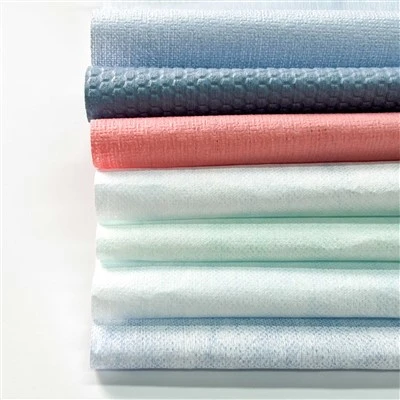
In recent years, non-woven fabrics have become an extremely important part of the textile industry. Technical developments in polymer, nonwoven processing and fabric finishing have greatly improved the physical and mechanical properties of the fabric, including fabric handling and drape, tensile properties, abrasion resistance, pilling and washing stability, dyeing and printing , Creating a prospect for the application of nonwovens. Especially in clothing jackets.
Non-woven fabric is a technical textile, ranking third in the manufacture of textile surface materials, second only to woven fabrics and knitted fabrics. Compared with woven and knitted fabrics, non-woven fabrics have many advantages: it can be designed to have specific target properties; it can vary greatly in thickness, mass, volume, elasticity and rigidity; relatively speaking, its The production speed is fast and the cost is low. Previous research data on the production of non-woven fabrics shows that the usage continues to increase. Non-woven fabrics are the most widely used textile products in the automotive industry, and their sound and vibration insulation performance is unmatched. Most of the non-woven fabrics used in the automotive industry are synthetic. Therefore, by correctly selecting fibers and performing subsequent treatments in the production process, the most stringent requirements for automotive textiles, such as non-flammability, can be met. 8-10 non-woven fabric is used as the back of the car seat and is part of the car seat cover. One of the problems related to this is the method of connecting the non-woven fabric to another material by sewing, which may cause the seam to be unstable. Therefore, choose the non-woven fabric with the best fiber density, compactness and softness.